
⚠️ Affiliate Disclosure: This post contains affiliate links. If you click and make a purchase, Lilly’s Corner may earn a small commission at no extra cost to you. We only recommend products we genuinely love and use. Thank you for supporting this blog! 🧡
When most people hear “core workout,” they picture endless crunches and a six-pack. But a strong core is about far more than looks. Your core is the group of muscles that wraps around your midsection — your abs, obliques, lower back, hips, and the deep stabilizing muscles that hold your spine steady. It is the link between your upper and lower body, and nearly every movement you make depends on it.
The good news is that you do not need a gym or fancy equipment to build one. This beginner core workout at home uses ten simple, joint-friendly exercises, clear form cues, and an easy four-week plan so you can start strong and progress safely. 💪
Why a Strong Core Matters
A stronger core supports almost everything you do, from carrying groceries to hiking uphill. Here is what consistent core training can help with:
- 🧍 Better posture: Strong deep core muscles help you sit and stand taller, which can ease the slouching that comes with desk work.
- 🔙 A happier lower back: A stable core takes pressure off your spine during daily movement. If you have ongoing back pain, check with a healthcare professional before starting a new routine.
- ⚖️ Improved balance and stability: Your core keeps you steady on uneven ground, which is a big bonus on the trail.
- 🏃 More power in every workout: Running, lifting, hiking, and yoga all rely on a stable trunk to transfer force efficiently.
- 🏠 Easier everyday movement: Lifting, bending, twisting, and reaching all feel smoother with a capable core.
Before You Start: Core Basics Every Beginner Should Know
A few simple principles will make every exercise below safer and more effective:
- Quality beats quantity. Ten slow, controlled reps are better than thirty sloppy ones.
- Breathe. Exhale on the effort and inhale as you return. Holding your breath raises tension and makes exercises harder.
- Brace gently. Imagine tightening your midsection as if someone were about to tap your stomach, without sucking in or flattening your belly.
- Protect your lower back. If you feel strain in your back instead of your abs, make the move easier or stop.
- Do not train through sharp pain. Mild muscle fatigue is normal, but sharp or pinching pain is a signal to stop.
- Warm up first. Five minutes of marching in place, hip circles, and gentle cat-cow stretches gets your body ready.
The 10 Best Beginner Core Exercises
1. Dead Bug
Targets: Deep core and lower abs. This is the best starting exercise for building core control.
- Lie on your back with your arms reaching toward the ceiling and your knees bent over your hips at 90 degrees.
- Press your lower back gently toward the floor and keep it there.
- Slowly lower your right arm overhead and your left leg toward the floor at the same time.
- Return to the start and switch sides.
Do: 2 sets of 6 to 8 reps per side. Easier option: Move just your legs and keep your arms still.
2. Bird Dog
Targets: Core, lower back, glutes, and balance.
- Start on hands and knees with your wrists under your shoulders and knees under your hips.
- Reach your right arm forward and your left leg back, keeping your hips level.
- Pause for a second, then return slowly and switch sides.
Do: 2 sets of 8 reps per side. Tip: Imagine balancing a glass of water on your lower back so it never spills.
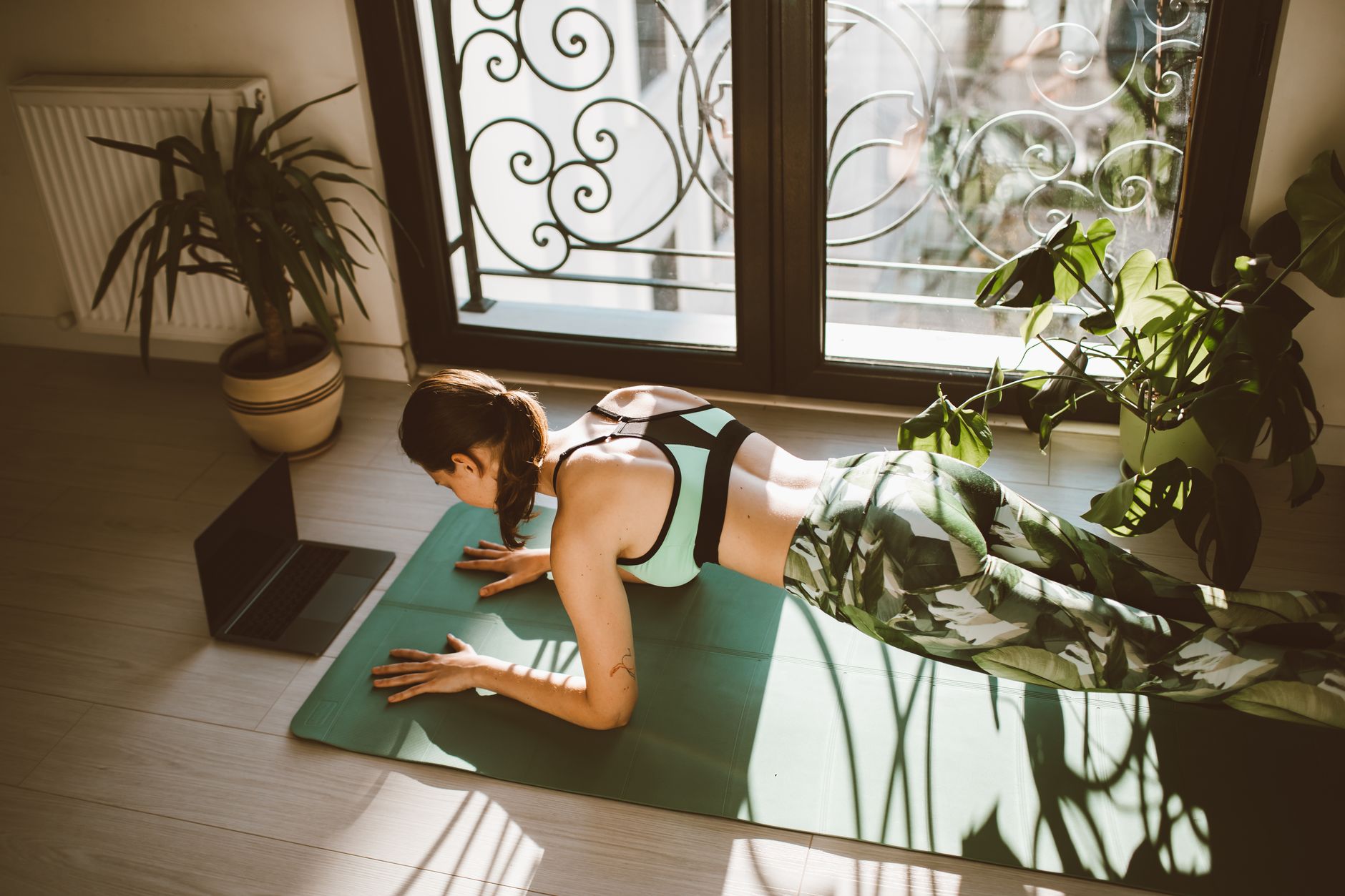
3. Forearm Plank (Knees Down to Start)
Targets: The entire front of your core, plus shoulders and glutes.
- Place your forearms on the floor with your elbows under your shoulders.
- Start with your knees down, or lift to your toes if you feel strong.
- Keep a straight line from your head to your knees or heels, with your glutes lightly squeezed.
- Hold while breathing steadily.
Do: 3 holds of 15 to 30 seconds. Tip: Stop the set when your hips sag, not when you are exhausted.
4. Glute Bridge
Targets: Glutes, hamstrings, and the back side of your core.
- Lie on your back with your knees bent and feet flat, hip-width apart.
- Press through your heels and lift your hips until your body forms a line from shoulders to knees.
- Squeeze your glutes at the top, then lower slowly.
Do: 2 sets of 12 to 15 reps.
5. Side Plank (Knees Bent)
Targets: Obliques and the sides of your core, which are key for spine stability.
- Lie on your side with your knees bent and your elbow under your shoulder.
- Lift your hips so your body forms a straight line from your head to your knees.
- Hold, then switch sides.
Do: 2 holds of 15 to 20 seconds per side.
6. Heel Taps
Targets: Lower abs, with very little strain on the neck.
- Lie on your back with your knees bent over your hips and your lower back pressed down.
- Slowly lower one foot to tap the floor, then bring it back.
- Alternate legs with control.
Do: 2 sets of 10 to 12 total taps.
7. Standing Knee-to-Elbow Crunch
Targets: Obliques and abs, in a back-friendly standing position.
- Stand tall with your hands behind your head and elbows wide.
- Lift your right knee and bring your left elbow toward it as you gently crunch sideways.
- Return to standing and switch sides.
Do: 2 sets of 10 reps per side.
8. Mountain Climbers (Slow Version)
Targets: Core, shoulders, and a gentle heart-rate boost.
- Start in a high plank with your hands under your shoulders.
- Slowly draw one knee toward your chest, then return it and switch.
- Keep your hips steady and your back flat.
Do: 2 sets of 10 to 16 total reps. Easier option: Place your hands on a countertop or sturdy bench.
9. Superman Hold
Targets: Lower back, glutes, and the muscles that balance your abs.
- Lie face down with your arms extended forward.
- Gently lift your arms, chest, and legs a few inches off the floor, keeping your neck neutral.
- Hold briefly, then lower with control.
Do: 2 sets of 8 reps with a 3-second hold.
10. Pallof Press (With a Resistance Band)
Targets: Deep core, which resists rotation. It is excellent for anti-twist stability.
- Anchor a resistance band at chest height to a sturdy post or door anchor.
- Stand sideways to the anchor, holding the band at your chest with both hands.
- Press your hands straight out in front of you without letting your torso twist, then bring them back.
Do: 2 sets of 10 reps per side.
Your 4-Week Beginner Core Plan
Aim for three core sessions per week on non-consecutive days. Each session takes about 15 to 20 minutes. Rest and recovery matter just as much as the work itself — if you need ideas, read our guide on how to recover faster after a workout.
- Week 1 — Learn the moves: Dead bug, bird dog, glute bridge, and knee plank. Do 2 sets each, focusing entirely on form.
- Week 2 — Add the sides: Add side plank and heel taps. Keep 2 sets of everything, and lengthen your plank holds slightly.
- Week 3 — Build endurance: Add the standing knee-to-elbow crunch and superman hold. Move to 3 sets of the exercises you find easiest.
- Week 4 — Challenge yourself: Add mountain climbers and the Pallof press. Try your plank on your toes, and aim to complete the full list of ten exercises in a circuit with a short rest between moves.
Once you finish the month, increase difficulty gradually by holding planks longer, slowing down reps, or adding resistance. Core strength also pairs wonderfully with a full-body routine — our beginner’s guide to strength training at home is the perfect next step.
Common Core Workout Mistakes to Avoid
- ❌ Pulling on your neck during crunches. Keep your head relaxed and lead with your ribs, not your chin.
- ❌ Letting your lower back arch. Press it gently toward the floor on lying exercises and stop the rep if it lifts.
- ❌ Rushing through reps. Momentum does the work for you. Slow it down.
- ❌ Holding your breath. Keep breathing throughout every exercise.
- ❌ Training only the abs. A balanced core includes your back, obliques, hips, and glutes.
- ❌ Doing too much too soon. Start with fewer sets and build gradually.
Simple Gear to Make Your Core Workout Better
You do not need any equipment to begin, but a few inexpensive items can make your sessions more comfortable and more effective:
- Thick, non-slip exercise mat — cushions your spine, elbows, and knees on hard floors — 👉 View on Amazon ↗
- Resistance bands set — perfect for the Pallof press and for adding challenge as you progress — 👉 View on Amazon ↗
- Ab wheel with knee pad — a great progression once your planks feel easy — 👉 View on Amazon ↗
- Stability ball — adds balance challenge to planks and bridges — 👉 View on Amazon ↗
- Interval workout timer — keeps your holds and rest periods consistent — 👉 View on Amazon ↗
- Foam roller — loosens tight hips and back after your workout — 👉 View on Amazon ↗
- Adjustable ankle and hand weights — a light way to progress dead bugs and bridges later on — 👉 View on Amazon ↗
Frequently Asked Questions
How often should a beginner train their core?
Two to three times per week is plenty for beginners. Your core muscles also work during walking, lifting, and other workouts, so they benefit from rest days too.
Can core exercises burn belly fat?
Exercise cannot target fat loss in one spot. Core training builds strength and muscle tone, while overall fat loss comes from your total activity, nutrition, sleep, and lifestyle habits. Strong core muscles are valuable regardless of what the scale says.
Do I need to do crunches?
No. Planks, dead bugs, bird dogs, and similar exercises train your core in a way that is easier on your spine and more relevant to daily movement. Crunches can be one tool among many, but they are not required.
When will I notice results?
Many people notice better control and stability within a few weeks of consistent practice. Visible changes depend on many factors, so focus on how you feel and how your strength improves.
Final Thoughts
A beginner core workout at home does not need to be complicated, long, or intimidating. Ten simple exercises, three short sessions per week, and careful attention to form are enough to build a stronger, more stable midsection over the next month. Start small, stay consistent, and give your body time to adapt.
If your posture also needs some attention, pair this routine with our simple daily posture exercises to support your spine from every angle. Roll out your mat, take a deep breath, and begin. 💪🧡
👉 Shop Beginner Core Workout Gear on Amazon ↗
Which core exercise is your favorite? Share it in the comments — we would love to hear from you! 💪
Leave a Reply